[This is fiction. It is made up. If you want to know the real history of the Mazda RX range and of rotaries in general, have a look at Monito.com's WRCE site.]
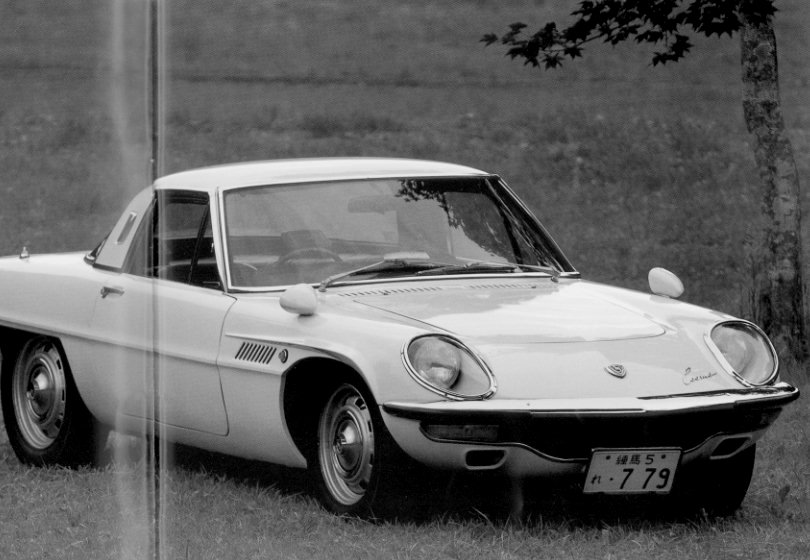
In 1963 Mazda made it public that they were interested in the Rotary engine. Kenichii Yamomoto was the prime mover behind the innovative engine and at the 63 Tokyo show Mazda's rotary engine concept was shown. However, it took Mazda four more years before Mazda had a car ready for the public. In 1967 that Mazda released the limited production Cosmo 110 sports car.
Little did Yamomoto-san realise that there was a competitor in the wings with an alternate idea that would overtake the technologically advanced, elegantly engineered, rotary engine with what, for the time, was a more conservative engine. Looking back, though, the competitor was almost as radical as the rotary.
Ichiro Tanaka was an anglophile - he loved all things British, especially cars and motorbikes. He had bought one of the few Daimler SP250s released in Japan in 1960 and also owned several Triumph motorcycles. In 1962 he bought a Daimler v8 250. The link between the seemingly genteel Daimlers and the Triumph 'bikes was their engines. The same man, Triumph engineer, Edward Turner, designed the V-twins in the Triumphs and the overhead-valve V8s in the Daimlers.
The Daimler hemi-head 2.5 litre V8 was compact and well designed. Essentially 4 v-twins sandwiched together it produced 140hp@5800rpm using two SU carburettors. It's main flaw was that the v-twins were originally intended to be air-cooled and in converting the v-twins to a water-cooled design the additions to the engine were inelegant and lead to overheating.
Tanaka-san thought that the small V8 was more than a match for the rotary that Yamomoto-san was so passionate about. The V8 made 140hp to the rotary's 100 and it was barely any heavier. Despite many more moving parts than the rotary, Tanaka knew the V8 would be easier to produce for the small Toyo Kogyo concern.
Tanaka set about designing a V8 based on the Daimler design but with the cooling flaws corrected. In 1964 he had a working prototype which he fitted to a discarded pre-production Cosmo 110 shell. The engine barely fit, Tanaka saying later that it was "like trying to fit a Sumo-wrestler into a Geisha's kimono".
Tanaka approached Toyo Kogyo management with a daring proposition: produce the Cosmo 110 in Rotary and V8 form and whichever sold the most, that would be the company's new performance direction.
In 1967 the Mazda Cosmo 110 was released with a rotary engine and the Mazda Cosmo 111 was released with Tanaka's Daimler-based V8. Shortly afterwards the NSU Ro80 was released with a rotary as its only engine.
In the first few months of the Cosmo 110/111 the 110 had higher sales but as reports of the rotary engines unreliability began appearing in the press the sales of the 111 took off. The Mazda Rotary's fate was set the fateful day when the company entered 110s and 111s into the 84 (eighty four!) Hour Nürburgring race. The 110 and 111 both finished though the 111 comprehensively beat the 110.
The demise of the rotary at Mazda had several effects. Yamomoto left the company and moved to France. Rumours of the time had that he was working closely with a new company called Comotor, owned jointly by Citroen and NSU. Today, 110s are sought after by collectors and sell for four times the price of similar quality 111s. Many 110s have had Citroen comotor engines transplanted in place of the 10a, though most owners now report that they are searching for parts to enable the 10a the be reinstalled.
Next:
In 1968, just one year after the ill-fated Cosmo 110 was released to the public the V100 was unveiled. It was Mazda's first full-production car to use the Edward Turner-inspired, Tanaka-designed, V8.

Subscribe to:
Post Comments (Atom)
No comments:
Post a Comment